Cursor vs Claude Code: $200 a Month vs $12,000 for Heavy Agent Use
Cursor now bills Claude at API price. A heavy month of agent work comes to about $11,900 there, against a $200 Claude Max plan with a cap. Where Cursor fits.
For agent work, Claude Code is far cheaper than Cursor, and as of October 2026 the gap is huge. Claude Code runs on a flat Claude plan. Cursor's new plans, announced October 12 as a bundle with Grok and X Premium, include no Claude or other third-party usage at all. Claude, Gemini and the rest are billed at API list price from the first token, on top of a plan that starts at $30 a month.
To see how far apart that is: a Max 20x plan costs $200 and holds roughly $3,000 of Opus work a week at API prices, about $13,000 a month if you use all of it. Cursor bills that work at those prices, so a month that fills one plan would cost about 65 times as much there. My own September of Claude Code, about 105,000 requests and 22 billion tokens, mostly Opus with some Fable 5.1 and much of it in parallel subagents, comes to $11,900 at Cursor's rates, roughly a fully used plan's worth. What Cursor still offers is its editor and its own models.
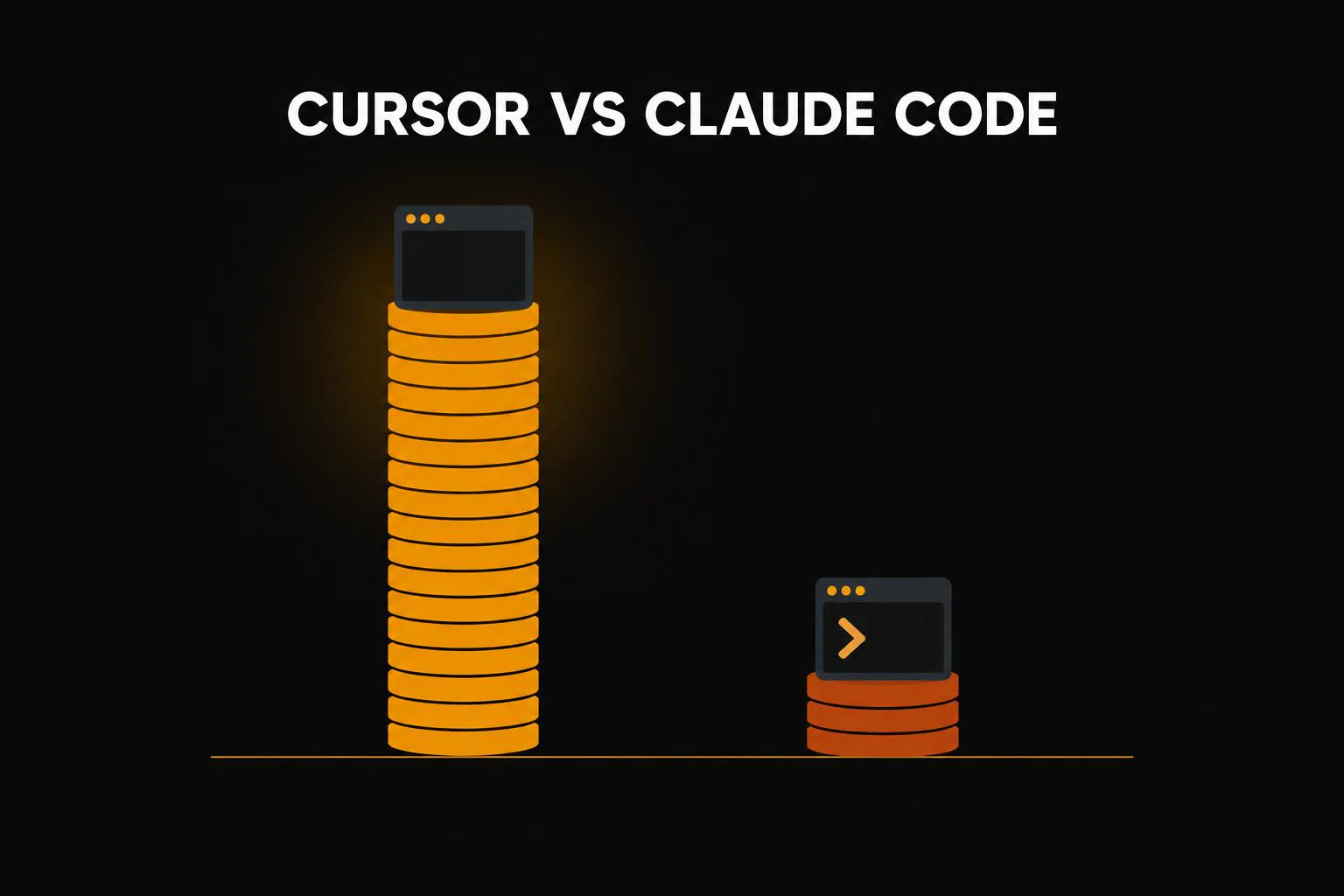
Cursor vs Claude Code on one real month of work
I didn't run this work through Cursor, so this is a re-pricing, not a test. Cursor's agent would have made its own calls and sent different tokens. I'm assuming it would have sent the same ones Claude Code logged, priced at the per-token rates Cursor publishes for the current version of each model. For Claude those rates match Anthropic's API list prices to the cent.
A heavy month of Claude work, billed at Cursor's rates
Show the numbers
| Day | Claude at Cursor's rates | Cursor running total |
|---|---|---|
| Sep 1 | $136 | $166 |
| Sep 2 | $628 | $794 |
| Sep 3 | $43 | $837 |
| Sep 4 | $188 | $1,026 |
| Sep 5 | $325 | $1,350 |
| Sep 6 | $302 | $1,653 |
| Sep 7 | $0 | $1,653 |
| Sep 8 | $73 | $1,726 |
| Sep 9 | $110 | $1,836 |
| Sep 10 | $32 | $1,867 |
| Sep 11 | $409 | $2,276 |
| Sep 12 | $148 | $2,424 |
| Sep 13 | $0 | $2,424 |
| Sep 14 | $210 | $2,634 |
| Sep 15 | $83 | $2,716 |
| Sep 16 | $6 | $2,722 |
| Sep 17 | $311 | $3,033 |
| Sep 18 | $626 | $3,659 |
| Sep 19 | $203 | $3,862 |
| Sep 20 | $0 | $3,862 |
| Sep 21 | $0 | $3,862 |
| Sep 22 | $386 | $4,248 |
| Sep 23 | $257 | $4,505 |
| Sep 24 | $19 | $4,524 |
| Sep 25 | $1,323 | $5,847 |
| Sep 26 | $2,189 | $8,036 |
| Sep 27 | $1,692 | $9,728 |
| Sep 28 | $534 | $10,262 |
| Sep 29 | $604 | $10,867 |
| Sep 30 | $1,074 | $11,941 |
The assumption is the soft spot, but it can't close a gap this big. If Cursor's agent had done the same work on half the tokens, it would still bill about $6,000.
Cursor's older plans did include API-priced Claude usage: $20 on Pro and, reportedly, $400 on Ultra. Existing subscribers can keep those plans for now, and there's no timeline yet for moving them over.
A Claude plan sells Claude below list price
Anthropic owns Claude, so it can price a capped plan at whatever that capacity is worth to it, and it's been generous. I ran Opus 5.5 work against a Max 20x plan's usage meter: one 5-hour window held about $300 of work at API prices, more than the plan costs for a month, and each window used about a tenth of the weekly allowance, which is where the $3,000 a week comes from. Cursor buys Claude from Anthropic and now passes it through at list price. It used to fold a little of that into its plans.
List price hurts agents more than chat because of how they use context. Every step resends the whole conversation, so 96% of my tokens were cache reads: cheap one at a time, but there are billions of them. At Cursor's rates my month splits roughly into thirds between cache reads, cache writes and output.
Team plans add to that. Cursor charges teams $0.25 per million tokens on every third-party token, cached ones included, which is more than Opus 5.5 charges for a cache read in the first place. On a month this size that fee alone comes to about $5,500.
Is Grok the cheap way to run agents in Cursor?
Cursor's plans do include a pool for SpaceX's own models, Grok 4.7 and Composer 2.5, so the obvious move is to switch. On the sticker Grok 4.7 looks cheap: half of Opus 5.5's input price, under a third of its output price. But a Grok 4.7 cache read costs $0.50 per million against $0.20 for Opus 5.5, and cache reads are where agents spend their tokens. At Grok 4.7's list price the same month comes to about $12,900, more than the Claude models I actually used.
The same September tokens at each model's list price
Composer 2.5, the cheapest model Cursor makes, comes to about $4,900. How much of that a plan covers is unknowable from the outside: Cursor states the included pool only as multiples of its $8 plan, 4x on Premium up to 50x on Ultra, shared with Grok's own apps, with no dollar or token figure. Anthropic does the same with its plans, so neither side lets you compare caps on paper.
OpenAI plans to pull its models from Cursor on November 12
Model choice was always Cursor's best argument against Claude Code: one editor, every frontier model. That argument is shrinking. After SpaceX bought Cursor in August, OpenAI said it would pull its models from Cursor, with November 12 as the proposed date, and supply no new ones. Cursor's CEO said he was talking to OpenAI to resolve it, so the date could move, but Cursor's model list already stops at GPT-5.6 and the GPT-6 models aren't on it. After a cutoff you can still use GPT in Cursor's chat and agent with your own OpenAI key, billed by OpenAI. Anthropic has said it will keep supporting Claude in Cursor.
Claude Code for the agent, Cursor for the editor
If you hand an agent long jobs or run subagents most days, take Claude Code on a Max plan. Nothing in Cursor's pricing comes close for Claude. The trade-off is the cap: when a 5-hour window runs dry your session waits for the reset, and the heaviest stretches of my September did that. Cursor never stops you; it keeps billing. Start on Max 5x at $100 a month and move up to 20x at $200 when the limit keeps stopping you.
If you like Cursor's editor, you don't have to choose. Claude Code's extension installs in Cursor, and the agent bills to your Claude plan, not to Cursor. Pay for a Cursor plan only for what it includes, which now means its own models and cloud agents. If you're still on an old Cursor plan with Claude usage built in, keep it as long as they let you.
In 2025 this comparison was about an editor versus a terminal. Now it comes down to who owns the model. Anthropic can sell Claude below list price because it's Anthropic's to sell. Cursor can only resell it at list, and the model it can afford to give away is Grok.
More from the Blog
Kling AI Pricing: What a Usable Second of Video Actually Costs
Kling AI pricing in dollars: what each plan costs per second of Kling 3.0, when the API is cheaper, and how rerolls and expiring credits change the answer.
Opus vs Sonnet: What a Finished Task Costs, and Why Effort Matters More
Opus vs Sonnet in Claude Code on eight coding tasks: every setting passed, so cost and time per task decide. Effort level moved the bill more than the model.