What Is OpenRouter? A Year of Its Numbers Shows What People Actually Pay For
What is OpenRouter? One API and one bill for 400+ AI models from dozens of hosts. What it charges, why the host matters, and what the free models really give.
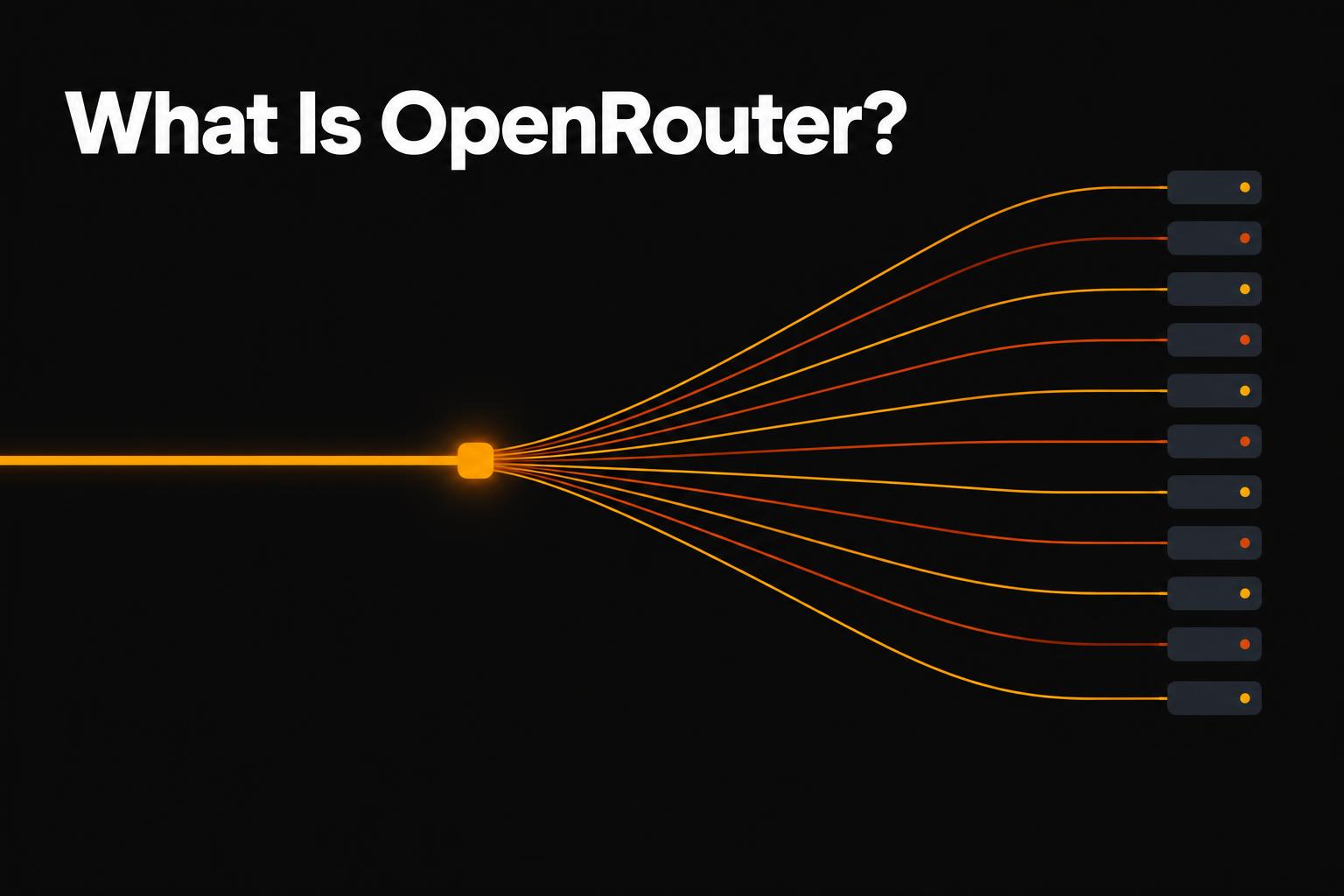
OpenRouter is one API, and one prepaid bill, for more than 400 AI models. You send a request in the OpenAI chat format with a model name like deepseek/deepseek-v4.1-flash, OpenRouter passes it to a company that runs that model, and you pay that company's per-token price. It adds no markup on tokens. It makes its money with a 5.5% fee when you buy credits.
The part that surprises people is that one model usually has many sellers. DeepSeek V4.1 Flash, the most-used model on OpenRouter as of October 2026, is served by 29 different hosts, priced from $0.04 to $0.60 per million input tokens, some of them running it at reduced precision. OpenRouter is the marketplace where those hosts compete for your request. Stripe agreed to buy the company in August 2026.
A year of OpenRouter's public usage numbers shows a clear split: open models, mostly from Chinese labs, now carry most of the traffic, while Claude and GPT collect most of the money. I also pinned one model to five hosts and sent each the same 150 tool-calling requests to see whether the host matters. Every host got the answers right, but the wait and the bill varied a lot.
What is OpenRouter doing with your request?
Each model on OpenRouter is really a list of endpoints, one per host. When your request arrives, OpenRouter pushes any host that has had a serious outage in the last 30 seconds to the back and spreads traffic over the cheapest of the rest, weighted so that a host at half the price gets four times the traffic. Since March 2026, requests that include tools are also ranked by each host's speed and how cleanly its tool calls have been coming back. If the chosen host fails, OpenRouter retries on the next one, and the response tells you which host answered.
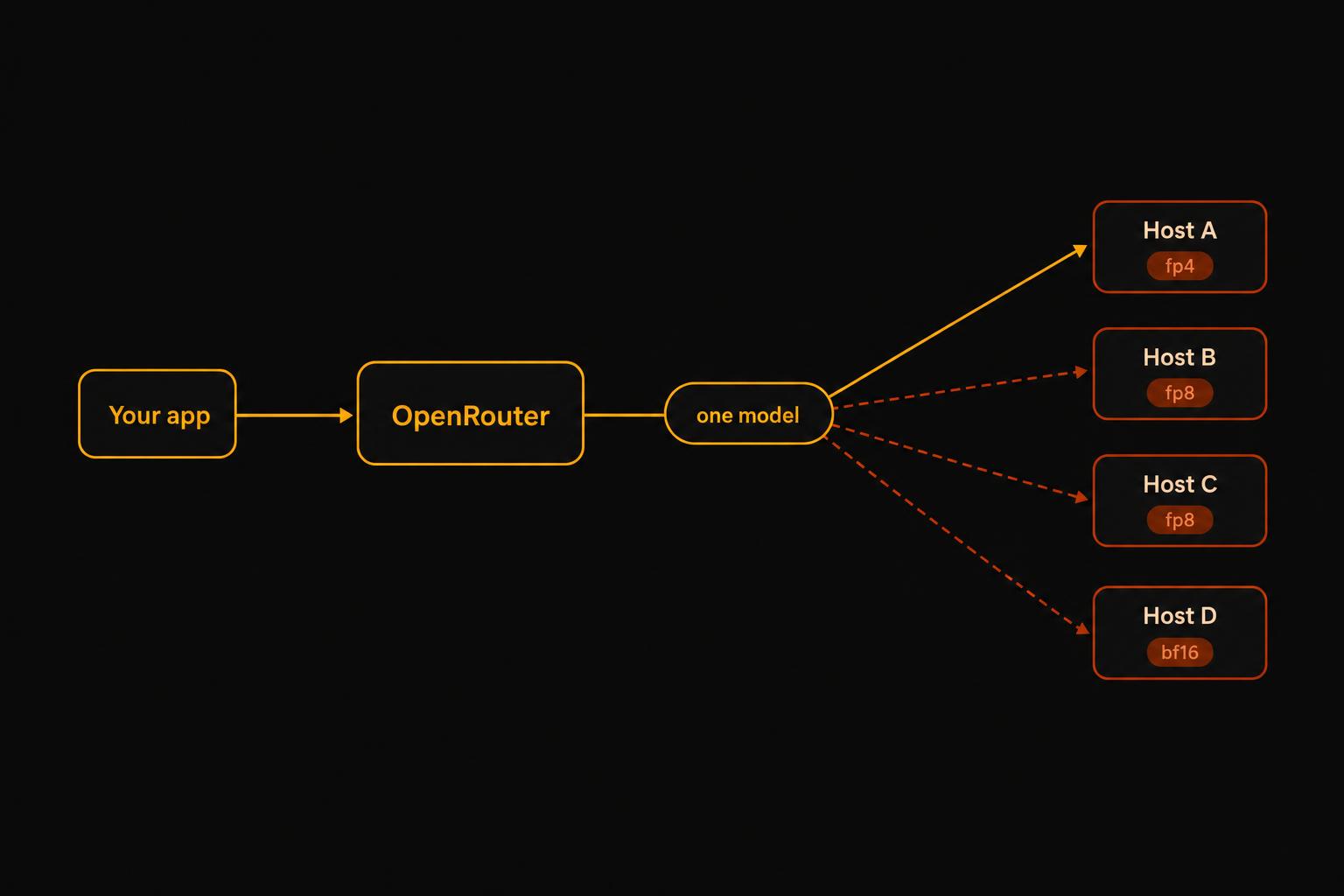
You can override all of it: pin a host, ban one, sort by speed instead of price, or refuse hosts that may train on your prompts. One key and one invoice for every lab is convenient, but that control is the better reason to use OpenRouter, because the same model is a different product on different hosts.
What you give up is the 5.5% and one extra network hop. If all your traffic goes to one lab at a negotiated rate, going direct is cheaper. For anything else, it's the easiest way to use many models without opening ten accounts.
Open models get the tokens, Claude and GPT get the money
In the four weeks to October 11, OpenRouter handled 612 trillion tokens and billed $99.6 million. Open-weight models processed 61% of those tokens and earned 25% of the money. Anthropic, OpenAI and Google together processed a fifth of the tokens and took two thirds of the money.
Who handles the tokens vs. who gets paid, Sep 14 to Oct 11, 2026
Single models make the gap concrete. DeepSeek V4.1 Flash handled one token in six and earned under 4% of the spend. The biggest earner, GPT-6 Astra, handled less than 1% of the tokens and took over 10% of the money.
My read on why: agents re-send their whole context on every step, so most tokens are cheap repeats of the same prompt, and that grind goes to whatever is cheapest and fast enough. The steps where a wrong answer is costly, like planning a change or fixing a hard bug, go to Claude and GPT, and that's where the money is. A good slice of the volume isn't paid at all: about 16% of the month's tokens were free, mostly one unnamed stealth model a lab is testing, plus free versions of open models.
This split is new. OpenRouter's weekly rankings name the nine biggest models by tokens and the nine biggest by spend. In October 2025, open models had under a tenth of the tokens among those nine and none of the money, and no open model made the spend list until Kimi K2.5 in February. Since then GLM, Kimi and DeepSeek have held up to four of the nine spend spots. Within that top nine, open models now carry about three quarters of the tokens and a quarter of the spend.
Open-weight share of OpenRouter's weekly top nine models, by tokens and by spend
Across the whole platform, weekly tokens grew 37 times over the year and weekly spend 11 times, so the average price paid per million tokens fell from $0.56 to $0.16. The per-model numbers are on our OpenRouter spend tracker, updated weekly.
OpenRouter free models: what you actually get
There are 15 free models as of October 2026, marked :free, plus an openrouter/free router that picks one for you. The published caps are 20 requests a minute and 50 a day, or 1,000 a day once your account has bought $10 of credits. Ours had, and when I fired 25 requests at one model at once, all 25 came back. On paper that's plenty for a side project.
In practice the hosts run out before you do. I sent 80 requests, spaced out over 17 minutes, to seven free models and the router, and 45 came back with an answer. Cohere's free coding model and the router answered every time. Gemma 4 31B answered none: its free host was rate-limited for all 10, and for a burst of 25 more. NVIDIA's Nemotron 3.5 Lightning answered everything, with a median wait of 29 seconds. Inkling refused all ten, since it only serves the agent apps on OpenRouter's list. The requests a host rate-limited didn't count against our daily allowance.
The real price is your prompts. When I told OpenRouter to skip hosts that may train on them, three of the free models wouldn't route at all. When I asked for zero data retention, none of the named free models would, and only the router found a host that qualified. I'd use free models to try a model or run something nobody depends on, start with openrouter/free if any decent answer will do, and keep anything private off them.
Does the host matter? I pinned one model to five of them
I pinned DeepSeek V4.1 Flash to five hosts (DeepSeek itself, DeepInfra, Together, StreamLake and OpenInference) and ran a sixth set that let OpenRouter choose. Each got the same 150 requests: 90 everyday tool calls, like finding a flight or setting a reminder, and 60 where the tool arguments had to be looked up in a 21,000-token product catalog in the system prompt. Every pinned request was served by the host I pinned.
DeepSeek V4.1 Flash on five hosts: every answer right, very different wait and bill
| Host | Median wait | Cost per 1,000 calls | Rate-limited |
|---|---|---|---|
Together precision not listed, $0.30/M input | 0.9 s | $0.59 | none |
Default routing OpenRouter picks the host | 1.5 s | $0.48 | none |
DeepSeek first party, $0.15/M input | 1.7 s | $0.22 | none |
DeepInfra fp8, $0.14/M input | 1.8 s | $0.20 | none |
StreamLake fp8, $0.147/M input | 2.2 s | $0.26 | 8 of 150 |
OpenInference fp4, $0.044/M input | 11.3 s | $0.47 | none |
Accuracy was the same everywhere. Every host got every request it answered right, with no empty replies and no broken JSON. I expected a gap, because OpenRouter found that steering GLM-5 traffic away from its worst hosts cut tool-call errors from about 8% to 1%. On this model, in October 2026, I didn't find one.
What changed was everything around the answer. Together answered the long requests in under a second at the median; OpenInference took 11 seconds, and one request in ten took over 36. StreamLake rate-limited 8 of its 150 requests, and because pinning switches off fallbacks, those came back to me as errors. The bill per request varied about threefold.
Default routing did well on reliability. It spread my requests over eight hosts, mostly Together and DeepInfra, and none failed. It wasn't the cheapest, though. It leaned on Together, the fastest and priciest host, which I'd guess is the tool-call ranking putting speed ahead of price, and its long requests cost about twice what pinning DeepSeek did. So I'd leave routing alone for anything with tools unless cost matters more than speed. Then list two or three hosts you've measured on your own prompts, not one, because with a single pinned host a rate limit becomes an error instead of a retry.
OpenRouter pricing: why the cheapest host can cost you more
The price list is simple: the host's per-token rate with no markup, plus the 5.5% fee (minimum $0.80) when you buy credits. If you bring your own API keys from the labs, the first $25,000 of usage a month carries no fee, and OpenRouter takes 5% after that.
The per-token price on a model page is still a poor guide to what a request costs. Agents send the same long prompt again and again, and hosts that cache it bill the repeats at a fraction of the price. In my test, OpenInference had the lowest list price at $0.044 per million input tokens and still cost more than twice as much per long request as DeepInfra at $0.14, because it cached about two thirds of the prompt where DeepInfra cached nearly all of it.
So compare hosts on what one of your real requests costs, which OpenRouter reports with every response. On the most-used model on the platform, choosing the host that way didn't change a single answer in my test, but it moved the wait more than tenfold and the bill threefold.
More from the Blog
Codex usage limits: where to check them, and what 1% of your week buys
Where to check Codex usage limits in ChatGPT and the CLI, and what 1% of a Plus week buys at API prices, measured from six months of my own Codex logs.
Claude Code Pricing: What a $200 Max Plan Holds at API Prices
Claude Code pricing runs $20 to $200 a month. I measured one Max 20x window at about $300 of Opus 5.5 work at API prices, and a week at about ten windows.