ChatGPT Images 2.6 GIFs Act Like Sprite Sheets: They Keep the Look, Lose Count
ChatGPT Images 2.6 GIFs behave like one sprite sheet cut into frames, so they keep the look and lose count. In 18 juggler runs, none kept three balls.
On November 4, 2026, OpenAI shipped ChatGPT Images 2.6 with animated GIFs, so I spent a few dollars on them through a third party that hosts the API. I asked 18 times for a street performer juggling three red balls. Not one run kept three balls through all nine frames.
Everything I can measure says the model paints a GIF as one big sprite sheet and cuts it into frames. I think that's why a character keeps his look while the ball count wanders. So I'd use it for what an animator would draw on one page, like walk cycles and stickers, and send anything that needs a camera or gravity to a video model.
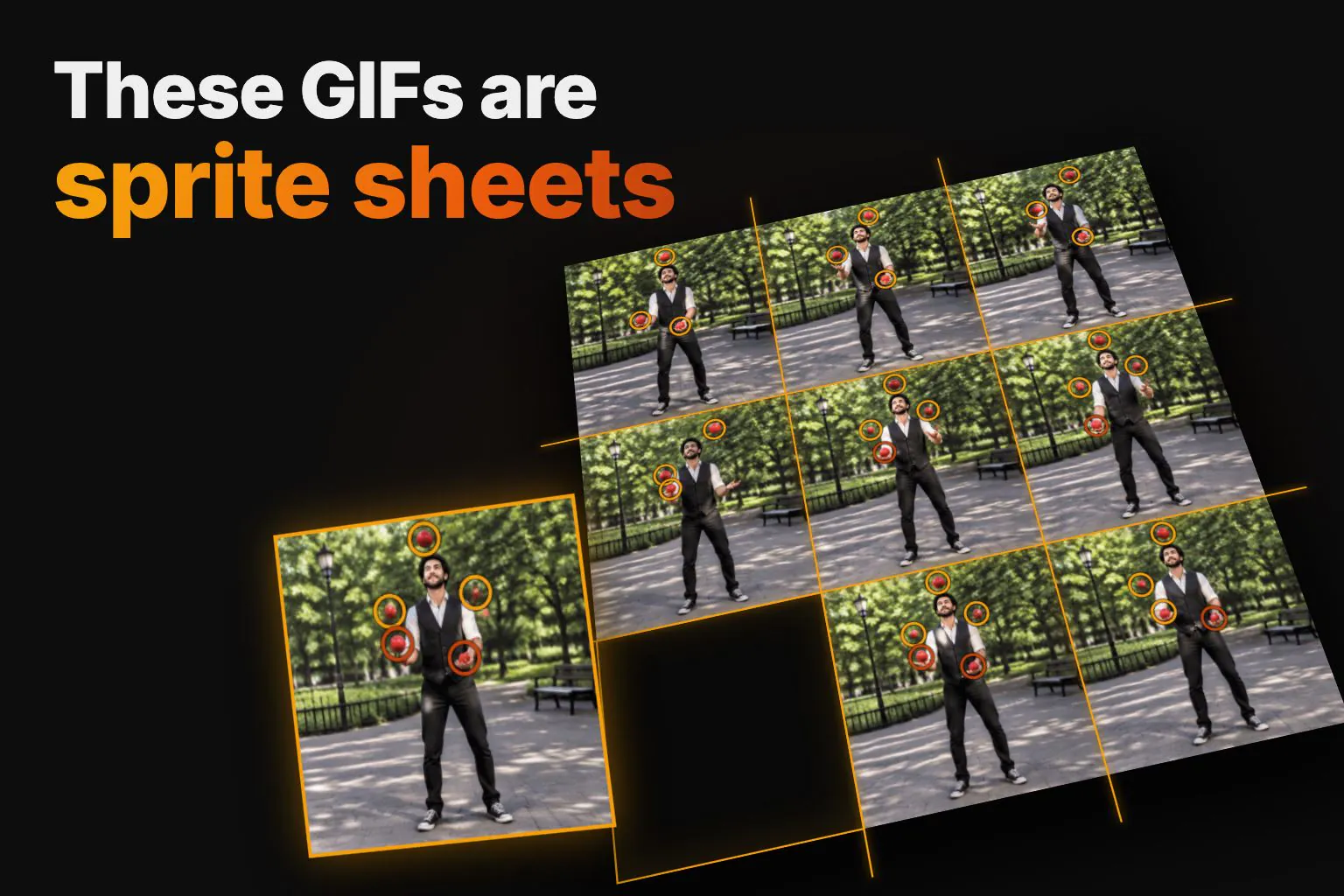
An error message gave away the sheet
OpenAI's image guide only mentions frames and a pixel budget. But nine frames at 976 pixels got me this refusal: "No supported sheet fits 9 GIF frames at size '976x976'. Invalid size '2928x2928'." That 2928 is three times 976, so nine frames is a 3x3 picture.
The message came through that third party, so "sheet" could be its word. The painted numbers can't be. A push-in down a Tokyo alley came back with 1, 2 and 3 in the corners of its first three frames, like panels on a storyboard.
So it keeps the look and loses count
My guess is that one canvas makes a shared look cheap, the way drawing nine poses on one page keeps a costume consistent. To test that, I mapped how much each pixel changes across nine separate pictures, then across the nine panels of one GIF.
But I suspect nothing on that canvas forces the ball in panel two to be the ball in panel one, the same weakness that gives image models the wrong number of fingers. You can see both in raw GIFs from Flare, the faster of the two API models.
Pixel-art walk cycle
Flare low

Waving sticker
Flare low
Three-ball juggler
Flare low: count them

Alley push-in
Flare low: top-right corner
But paying more only gets you closer
The other model, Sunburst, is slower. I ran each once: Flare at low quality got four of nine frames right and Sunburst at medium got eight, so my first draft said to pay for Sunburst. But I'd changed the model and the quality together. I ran all four combinations and counted every ball by eye.
At medium the two models land one frame apart, so I'd skip Sunburst, which takes about twice as long. Medium does lift the average, from 5.5 right frames to 7.5, but it still never got all nine.
ChatGPT Images 2.6 gets the cycles, and video gets the throws
So I gave Sunburst and Wan 3.0, Alibaba's video model, the same starting frame and prompt for a juggler and a running dog. I pinned each video's last frame to its first so it would loop. The video juggler keeps three balls and the dog gets a real camera. But pinning only moves the seam, so keep an eye on the dog's legs near the end.
I'd make game walk cycles, reaction stickers and flickering signs at Flare medium. For anything that moves through space, I'd make the still with Images 2.6 and hand it to a video model, and only pin the last frame if the camera stays put.
I never tested ChatGPT's own GIFs, though I'd expect them to work the same way.
More from the Blog
NVIDIA MotionBricks: The 15,000 fps Isn't the News
MotionBricks' 15,000 fps is mostly a counting choice. I ran it on a laptop. The news is fast, smooth and accurate at once, enough to replace game transitions.
Do AI music detectors work? They catch Suno and miss open models
I ran 29 songs through three AI music detectors you can download. The best caught every Suno song and no human ones, but passed 8 of 10 ACE-Step songs as human.