NVIDIA MotionBricks: The 15,000 fps Isn't the News
MotionBricks' 15,000 fps is mostly a counting choice. I ran it on a laptop. The news is fast, smooth and accurate at once, enough to replace game transitions.
On October 23, 2026, NVIDIA released MotionBricks in full. You give it the last four poses a character played and up to four it should hit, and it writes every frame between, on a skeleton. The paper claims "2ms latency and 15,000 FPS throughput", and the 15,000 is what went viral.
So I multiplied out NVIDIA's comparison table and ran the model on my laptop, and that number mostly reflects how you count. What's new is that it's the only model in the table that's fast, smooth and accurate at once, and I think that's enough to replace the hand-wired transitions in a game.
The 15,000 is mostly a choice of how you count
The table lists fps and latency for twelve rival setups. Multiply the two and you get frames per call: every rival lands near 64, and MotionBricks on exactly 30. The paper never defines the column. My guess is it credits MotionBricks with fewer frames per call. At 64 frames, 2 ms would be 32,000 fps, the top of the table.
I ran it on my M1 Pro's CPU, with poses I built by hand, and forced it to write 18 frames, then 58. Both took about 35 ms, so its fps mostly depends on how many frames you credit to each call. I'd compare latency instead.
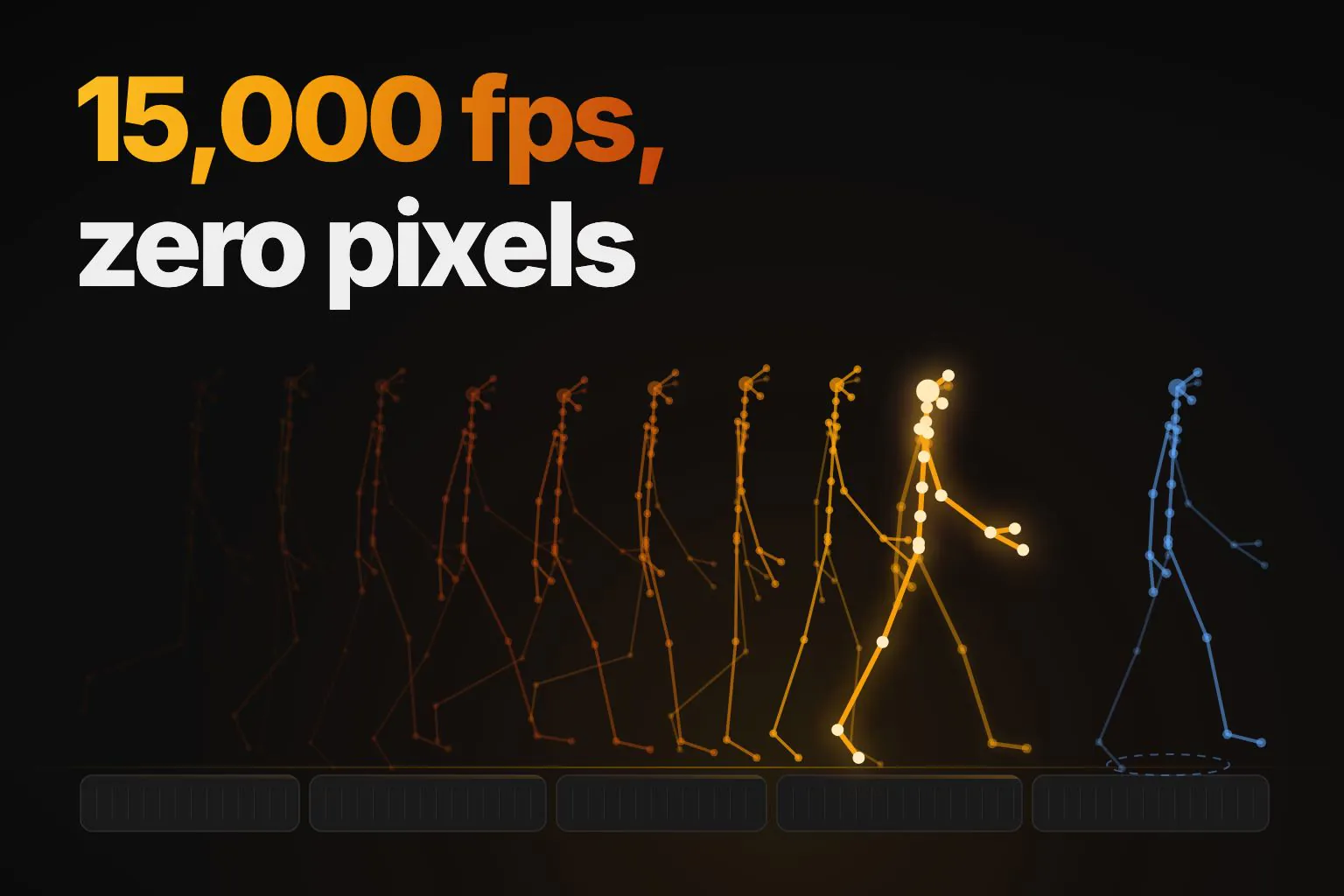
It never draws a pixel; each frame is a list of joint numbers.
But fast was the easy part
Every rival writes poses too, and older ones were already quick. They just gave things up. A 2022 model answers in 2.4 ms and jitters five times as much as real motion capture, or mocap. A 2024 model is much smoother but reaches its target only about a third of the time. MotionBricks takes 2 ms, matches mocap and reaches 99.6%.
These are NVIDIA's numbers, and rival latencies come from their original papers, so hardware differs. A faster GPU still wouldn't fix a model that misses. Put latency against jitter and only one dot lands where a game needs it.
So with MotionBricks, a new move costs a few poses
That combination is what a game needs. A game character runs on an animation graph, a hand-wired web of clips and blends, and it grows by pairs: a new move needs a route in from every state it can follow.
MotionBricks writes those transitions on demand, so you only place poses. Its bricks, Smart Primitives, are target poses pinned to an object, and NVIDIA says a non-expert can author one in under 10 minutes. I rebuilt its duck-under by hand, a bar with a walking pose in front and a crouch beneath, then turned the bar.
The model never saw that bar. Its head clears because I told it to crouch there, so avoiding walls stays your job.
I'd start with NPCs
If I were shipping a game, I'd move NPC walking and traversal over first, and keep authored clips for a player's attacks, where a hit has to land on an exact frame and nothing here promises that.
What I still don't know is how many characters a real game can carry, because NVIDIA doesn't say how many its own demo runs.
More from the Blog
ChatGPT Images 2.6 GIFs Act Like Sprite Sheets: They Keep the Look, Lose Count
ChatGPT Images 2.6 GIFs behave like one sprite sheet cut into frames, so they keep the look and lose count. In 18 juggler runs, none kept three balls.
Do AI music detectors work? They catch Suno and miss open models
I ran 29 songs through three AI music detectors you can download. The best caught every Suno song and no human ones, but passed 8 of 10 ACE-Step songs as human.