How Diffusion Models Work: A Game Boy Shows They Decide Early
I changed a Game Boy diffusion model's subject mid-drawing. By step 6 of 16 the new request only ties the old one, and the canvas is still 83% noise.
In October 2026 a developer posted a diffusion model running on a Game Boy Color. It turns static into a 28x28 doodle in about 85 seconds, on a CPU that can't even multiply. Flux and Stable Diffusion run the same basic loop, but this one is small enough to take apart.
So I took its public weights and changed its subject mid-drawing. By step 6 of 16 a new request only ties the old one, and the canvas is still 83% noise. The model picks early and mostly renders that pick, which changes how I read a preview and what I do with a bad seed.
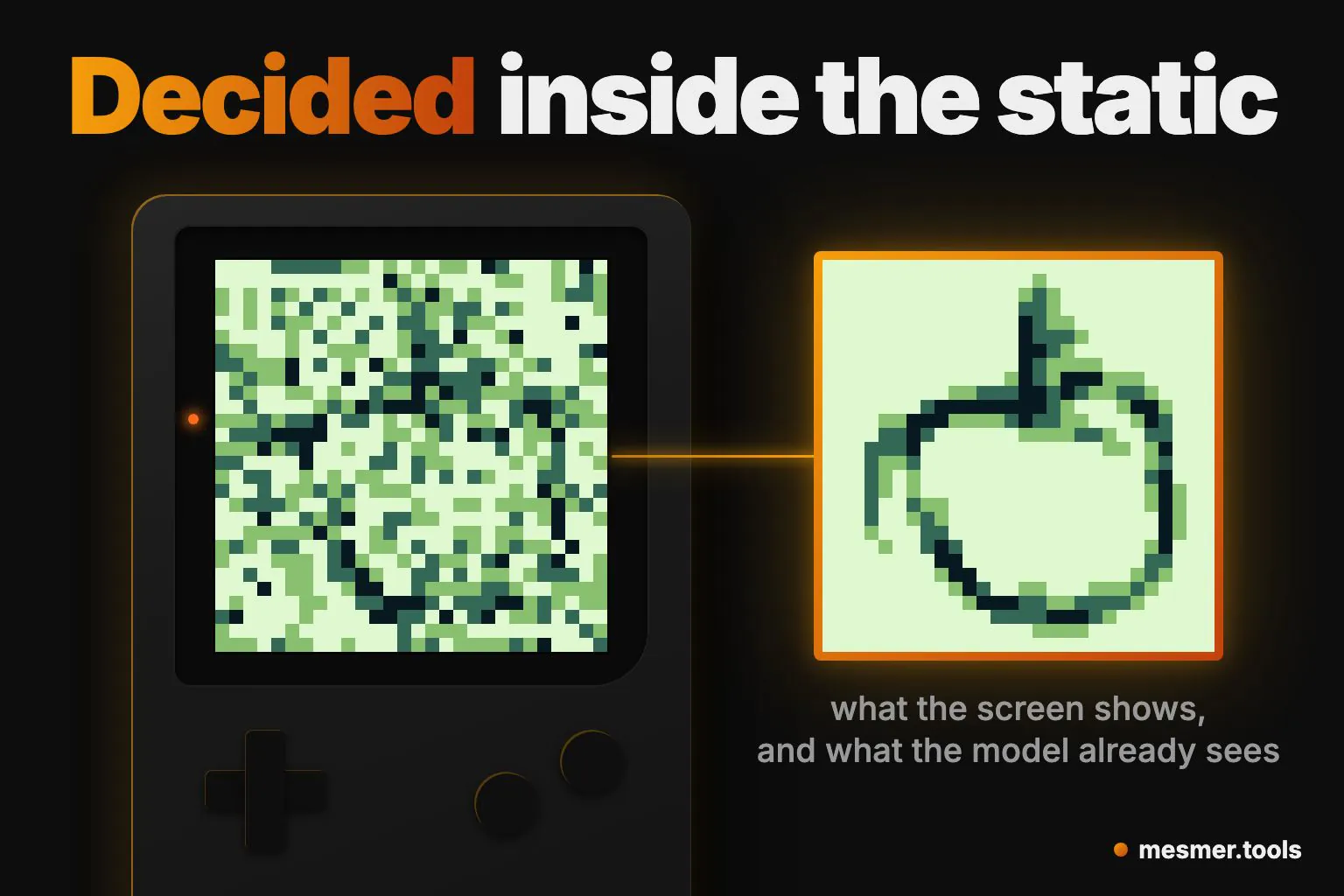
How diffusion models work: every step guesses the finished picture
Training buries a real doodle under noise and asks the network for the clean one back. Drawing is the same exercise with a lie: pure static, plus the claim that there's an apple in there. Keep an eye on how little of each guess reaches the canvas.
Unlike an LLM, which commits one token at a time, the model redraws the whole picture every step. The guess gets there long before the canvas does.
So I changed the request mid-drawing to see when it commits
A model that redraws everything could change its mind right up to the end. The label goes in fresh at every step, so I tested that: same noise, an apple for a few steps, then a fish. Look hardest at the middle of this row.
One row could be a fluke, so I ran eight swaps from 200 starts each and had a classifier I trained name every finished drawing.
So I'd judge the seed early and stop paying for steps
If you use ComfyUI, you've been watching this all along: its KSampler preview decodes the model's guess, not the noisy canvas. I'd judge a seed a third of the way through and cancel the bad ones there. That's my bet from a 28x28 network, and one study of Stable Diffusion XL found the base model reaching a large share of its final structure about 30% of the way through.
Halving the steps barely changes the drawing. Here are the same 12 starts at 8 and 16 steps.
Steps turn a guess into pixels. Only a better guesser draws a better apple. So once the preview has settled, I'd bet more steps won't fix a six-fingered hand, and I'd spend the next run on another seed.
What I don't know is whether big models commit on this schedule, because I haven't measured one. You can find your own model's line by switching the prompt partway: [apple:fish:0.4] in the A1111 family, ConditioningSetTimestepRange in ComfyUI.
More from the Blog
How do LLMs work? One loop explains almost everything they do
How do LLMs work? They predict one token, append it and repeat. Real probabilities from a real model show how that loop explains chat, tools and hallucination.
This Seedance AI Film Cost $28,775: Half the Runtime, Same Bill
This Seedance AI film cost $28,775, about what a film nearly twice as long cost. The team got better at retries, but the episode bill didn't shrink.