This Seedance AI Film Cost $28,775: Half the Runtime, Same Bill
This Seedance AI film cost $28,775, about what a film nearly twice as long cost. The team got better at retries, but the episode bill didn't shrink.
On October 30, PJ Accetturo's team posted episode 7 of their AI film series Nexus and said it cost $28,775. It runs 3 minutes 27 seconds. Seedance 2.5, the ByteDance video model they use, lists at about 57 cents a second at 1080p as of November 2026. One render of the whole film is $118.
Nobody has published where the rest went. What we do have is the series' Sky Line Heist, six weeks earlier, which cost $29,575 for 6 minutes 33 seconds. So the bill held while the film lost almost half its length, right after the team announced a fix that "saved a ton of money." My read is that about $29,000 is what an episode gets, and better technique buys a better film instead of a smaller bill.
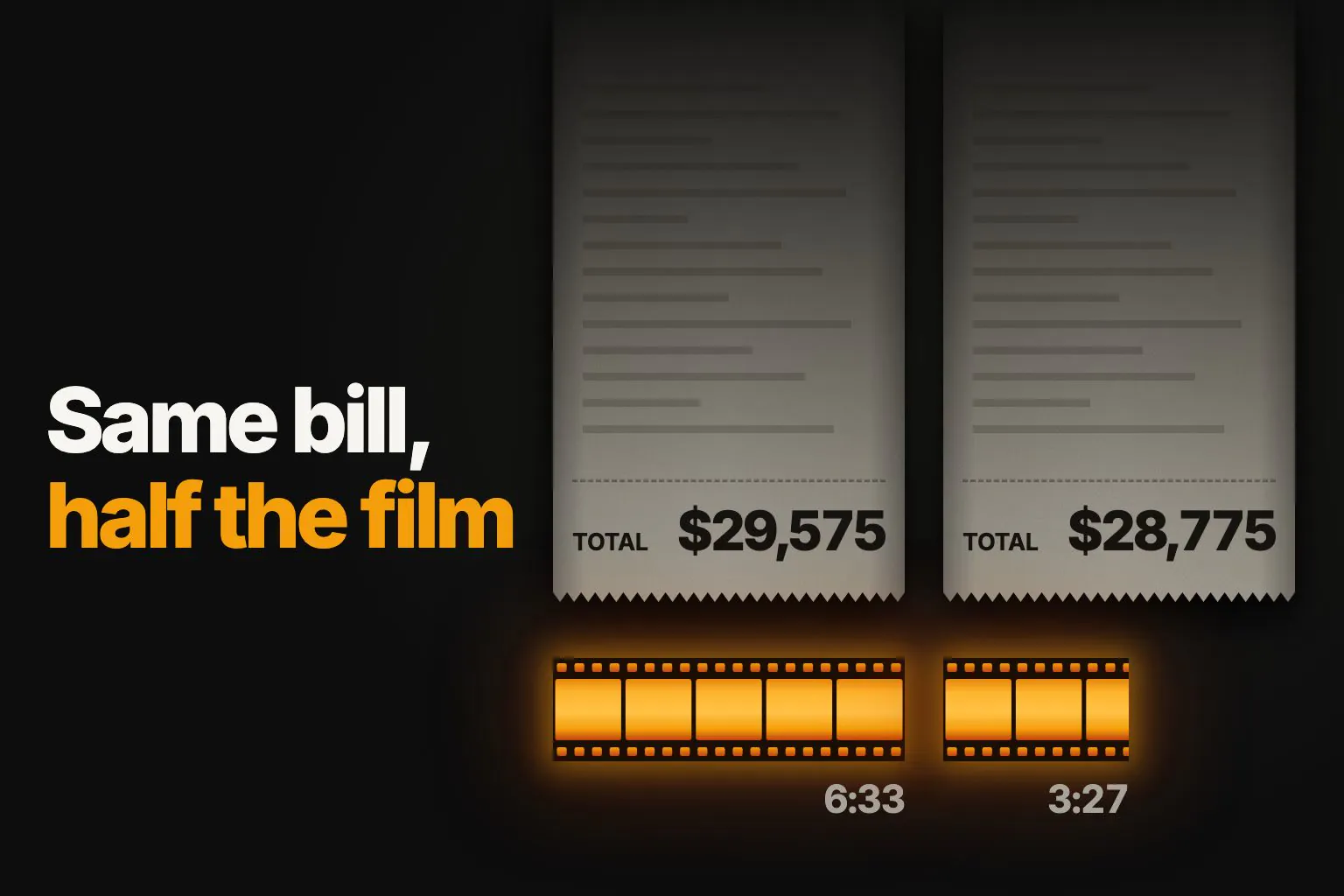
The Seedance AI film cost stayed put while the film shrank
The team has written that they spend "tens of thousands of dollars per episode" on the way to a "$200M looking feature film." Episode 7 may also just be harder material, and I can't rule that out.
So I worked out both films per finished minute and put them on one ladder, from the sticker price up to Hollywood.
But the fix is real
The team says the previous episode burned "$2,000 per DAY on generations for WEEKS," because the model kept getting the direction wrong: wrong camera, wrong blocking, ships changing size between shots.
Those misses multiply, because it all has to land in the same take. Say camera, blocking and performance each land one time in three (my illustration, not a measured rate). Getting all three together takes 27 tries on average. Keep each one as it lands and it takes 9.
The team's making-of doc reaches for a slot machine too, with the rule "keep what works and regenerate only what doesn't." Its best example is a close-up that kept reading as sarcastic until they rewrote the nod as "a single flat head movement with a completely blank face." Follow one frame from gray boxes to that face.
So the retries got cheaper and the episode didn't
Hold the money fixed and a better workflow shows up on screen. Hold the quality fixed and it shows up on your bill. These episodes suggest this team holds the money, so I wouldn't expect budgets to fall.
With a Seedance budget of my own, I'd decide first which one I'm holding fixed, the money or the quality bar. The per-second sums are the easy part, and our Kling pricing breakdown does them for Kling.
What I still don't know is how much of that $28,775 was generations at all. The team is a ByteDance partner, and nobody says what they pay or whether the total is cash or credits. My guess is the next episode costs about $29,000 again, and if it comes in at half that, I've read this wrong.
More from the Blog
How do LLMs work? One loop explains almost everything they do
How do LLMs work? They predict one token, append it and repeat. Real probabilities from a real model show how that loop explains chat, tools and hallucination.
How Diffusion Models Work: A Game Boy Shows They Decide Early
I changed a Game Boy diffusion model's subject mid-drawing. By step 6 of 16 the new request only ties the old one, and the canvas is still 83% noise.