ChatGPT vs Claude: Which $20 Plan I'd Actually Pay For
ChatGPT vs Claude on eight everyday tasks: GPT-6 Sol and Sonnet 5.5 answered about equally well, so the $20 choice comes down to what each plan bundles.
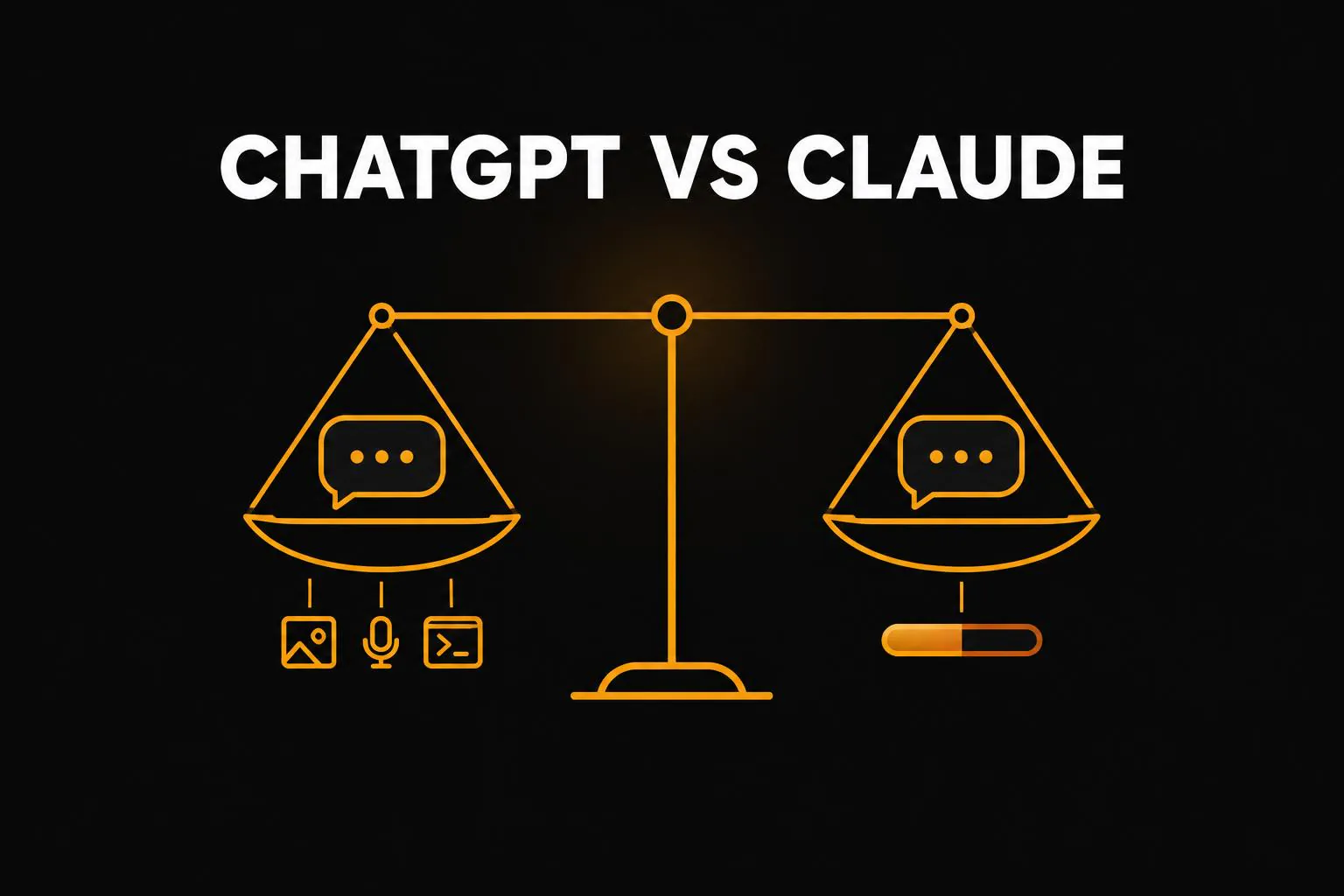
On everyday tasks ChatGPT Plus and Claude Pro answer about equally well, so the $20 choice comes down to what each plan bundles around the model. ChatGPT Plus adds image generation and Codex, which has a weekly meter of its own. Claude Pro adds Claude Code, but chat and Claude Code share one usage meter, so a long coding session can lock you out of chat until the window resets.
I gave GPT-6 Sol and Claude Sonnet 5.5 eight tasks, each with a catch built in: a spreadsheet with a duplicate row, a contract stacked against you, a meeting that changes its mind halfway through. Seven had a right answer. Sonnet got all seven. GPT-6 Sol got six at its Instant setting and the seventh, a spreadsheet average, once I turned thinking up. If I could keep one $20 plan, it would be ChatGPT Plus. Claude Pro is the pick if you want Claude Code, or answers that tell you what to double-check.
What $20 gets you on each side
| ChatGPT Plus | Claude Pro | |
|---|---|---|
| Price | $20/month | $20/month, or $17/month billed yearly |
| Coding agent | Codex, on its own weekly meter | Claude Code, on the same meter as chat |
| Makes images | Yes | No |
| Chat limits | Set by the model and thinking level you pick | One allowance per 5 hours plus a weekly cap, shared by everything |
The shared meter is what you'll feel on Claude Pro. Claude Code, the Claude app and the website all draw on the same five-hour session and the same weekly cap, so an afternoon of Claude Code can leave you waiting for the window to reset before you can ask Claude anything else. As of October 2026, Anthropic describes the allowance only as at least five times the free plan's per session, never in messages or tokens, and I haven't measured Pro's.
Codex goes a long way on Plus. Through the summer a Plus week held about $100 of work at API prices in my logs, and a single reading in October suggested several times that. The measurements and their caveats are in the Codex limits post. I haven't verified ChatGPT's current chat caps, so check OpenAI's limits page for your plan before you rely on one.
ChatGPT vs Claude on eight everyday tasks
These answers came from the models, not the consumer apps: Sonnet 5.5 as a Claude Code subagent, and GPT-6 Sol in the Codex CLI on my Plus plan with reasoning off, the closest match to Instant. Each model saw each task once, with no web search, code execution or memory, and I wrote the answer key before reading either output. I knew which model wrote what, so it isn't a blind test. Most tasks hide a catch, because a fluent answer to an easy question tells you nothing.
| Task | The catch | GPT-6 Sol (Instant) | Sonnet 5.5 |
|---|---|---|---|
| Rewrite an angry email to a landlord | Under 120 words, keep every fact | 83 words, every fact kept | 91 words, every fact kept |
| Q3 revenue by region from a pasted CSV | A duplicate row and a refund; counting either changes the winner | Right region, wrong total and average | Right, flagged both |
| Freelance contract: what to push back on | Five one-sided clauses | All five | All five |
| Fix a billing-period function | A crash, a December bug, and billing days that drift | All three fixed | All three fixed and explained |
| Summarize a 90-minute meeting for someone who left early | The date moves at minute 51; he gets two jobs after leaving | Right, missed the demo-bike risk | Right, flagged the missing handover; one quote misattributed |
| Why did Apple drop the iPhone mini in 2025? | Wrong year, and unit sales aren't public | Corrected the year, gave no number | Corrected the year, gave no number |
| Which job offer pays more | The bonus is only a target | Right, no break-even | Right, with the break-even |
| LinkedIn post about leaving a job | No right answer; style only | Plain, no hashtags | One emoji, four hashtags, invented details |
Down the columns the gap is small. Both caught all five bad clauses in the contract, and both rejected the iPhone question's wrong year without inventing a sales figure. Sonnet wrote about 3,350 words to GPT's 1,140, and most of the extra went into what to check next. My guess is that part of that gap comes from Codex favoring short replies, so I'd weigh it lightly.
The one wrong answer came with thinking off
Both models found the duplicate order and the refund, and both named North. Then GPT-6 Sol put the Q3 total at $17,063 instead of $16,163, which pushed its average to $741.87, and set both in the same bold as the right answer.
“Here's our Q2-Q3 order export. Which region had the highest revenue in Q3 (July to September), counting only completed orders? And what was our average order value in Q3? Flag anything in the data I should know about.” The CSV followed. Right answer: North at $5,077, out of $16,163 in total, so $702.74 per order.
North had the highest Q3 revenue: $5,077.00. Across all regions, Q3 completed-order revenue was $17,063.00 from 23 unique orders, giving an average order value of $741.87.
[…] The export contains an identical duplicate of order 1014; counting it twice would add $1,956.00 to West's revenue and inflate the average. I counted it once. I also excluded the refunded order 1016 and the three June orders.
North had the highest Q3 revenue, at $5,077, and Q3 average order value was $702.74. Both figures depend on two data issues […]
Order 1014 appears twice. […] If both rows counted, West would reach $6,680 and beat North […]
Order 1016 was refunded. […] Counting it would give East $5,976, which would also put East ahead of North.
With reasoning off, the model adds up 23 orders in one pass as it writes, and a single slip anywhere lands in the total. Sonnet had thinking on in my setup, so this isn't a like-for-like contest. When I reran GPT-6 Sol with thinking at medium, it spent about 300 tokens working and got both numbers right. For anything with arithmetic in it, raise the thinking level yourself or check the sum.
Both caught what changed in a meeting they never heard
This was the task I expected to split them. The launch date is agreed at minute 8 and dies at minute 51, someone repeats the old date later, and Marcus picks up two jobs after he's gone. Both models got all of it: March 24 for the US, April for the UK, the launch page by February 10 and the supplier contract by February 20.
“Here's the transcript of yesterday's launch meeting. I'm Marcus and I had to drop off early. What did we decide, and what do I need to do?” The transcript runs about 8,500 words.
Marcus, the biggest change after you left was the launch date. A battery shipment slipped by three weeks, so the team replaced the March 3 plan with a US launch on March 24. The UK launch is planned for April, with the date still to be confirmed after retail certification. […]
By February 10: Update the launch page copy. […]
By February 20: Take over the Norvik battery supplier contract from Dana and confirm the final terms.
Short version: the March 3 date you signed off on is dead, and you were handed two tasks after you dropped off.
Take over the Norvik battery supplier contract, due Friday Feb 20. This was Dana's, with a Feb 13 deadline. […] You were volunteered in absentia. Priyanka said “we'll tell Marcus,” […] so confirm the handover with her.
Update the launch page copy by Tuesday Feb 10. […] It should say US March 24 and UK “coming in April.”
Sonnet's version adds what a good colleague would: nobody actually told Marcus, so he should confirm the handover, and the dozen demo bikes he promised are now at risk. GPT-6 Sol said his demo-bike commitment was unchanged, and with thinking turned up it still didn't flag the handover. The job offers were closer: Sonnet worked out how much of the bonus has to pay out before B wins, and GPT-6 Sol did the same once it could think.
Which $20 plan I'd pay for
For most people, ChatGPT Plus. With thinking on, its answers were as right as Claude's on these tasks, only shorter. It makes images, which Claude can't, and Codex has a meter of its own.
Claude Pro is the pick if you want Claude Code, or answers that walk you through what to check, as long as one meter for chat and coding suits you. It's also the cheapest way to find out whether Claude Code fits. If it becomes your main tool, Max at $100 or $200 holds five and twenty times Pro's session.
If coding is why you're shopping, the chat tasks above won't help you. On eight coding tasks every run passed on both sides, and what separated them was speed and cost, which is what Codex vs Claude Code covers.
More from the Blog
The best realistic AI image generator, judged on 12 photos built to trip it up
The best realistic AI image generator costs about 4 cents: GPT Image 2.5 on high and Nano Banana 2.1 passed 11 of 12 photo tests. Max only helps close-ups.
Claude Code Alternatives: OpenCode With DeepSeek, GLM, Kimi and Qwen, Priced per Task
Claude Code alternatives, priced per finished task: OpenCode with DeepSeek cost about a cent, GLM-5.3 cost what Sonnet did, and the host set the bill.