Claude's Watermark Flags Your Own Words If Claude Rewrites Them. I Built One to Check
Claude hides a watermark in its word choices. I built the design: a rewrite of your own words looks generated, and a paraphraser scrubs the mark away.
In November, Anthropic extended its text watermark to older Claude models, so nearly every model now hides one in what it writes, with no documented setting to turn it off. You can't check your own text either: as of November 2026 the detector is open only to Anthropic and a private preview list that includes regulators, law enforcement and schools.
Anthropic calls the design a version of Google DeepMind's published SynthID-Text, so I built that on a small open model with my own key and gave it a paragraph of mine to work on. Fixing the typos left no trace. A "more professional" rewrite scored like a generated essay. My read is that the detector mostly lands on people who let Claude polish their own words, because anyone who wanted to hide can paraphrase the mark away. Every score here is from my build, because Claude's threshold and error rate aren't public.
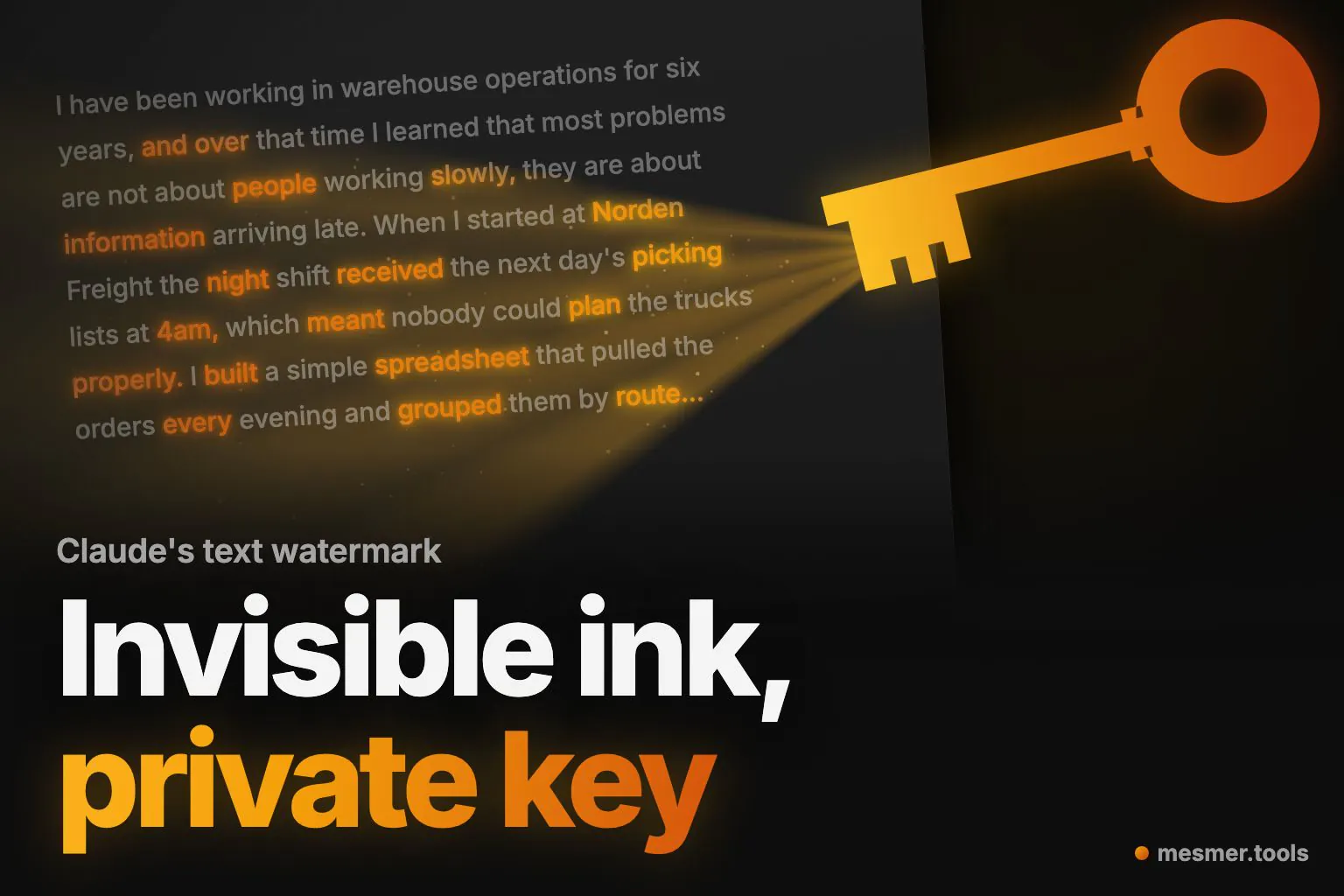
How Claude's watermark picks words
A model writes one token at a time, a word or a piece of one, by scoring its options and rolling weighted dice. The watermark swaps the dice for a tournament settled by a secret key and the last few tokens, so Claude still picks words it would have considered anyway.
A detector holding the key adds up agreement across the passage. I drew my line at a score of 4, which luck reaches about once in 31,600 tries. Here's one word of a cover letter being picked, then the score building.
One word proves nothing, so length decides, though a study of the public SynthID code on bigger models caught far fewer.
But a rewrite of your own paragraph looks generated
So on long text it works. Then I wrote a cover-letter paragraph myself and gave the marked model three jobs: fix the typos, translate a Spanish version, and make it more professional. When you correct "recieved", nearly every position has one right answer, and a forced word can't carry a mark. A rewrite leaves most tokens open.
Anthropic concedes the detector can't tell "Claude wrote this" from "Claude heavily edited this". The dyslexic writer who asks for a cleaner draft gets text whose ideas are theirs and whose word choices, to the detector, are Claude's. The detector asks whether a keyed model picked these tokens, and people will hear "did Claude write this?".
So who actually gets found?
The real risk is a school getting a yes on text whose ideas were yours, on a check you can't rerun, with no published error rate. But someone actually trying to hide has an easy way out: ETH researchers attacked the design, not Claude, directly, and an off-the-shelf paraphraser scrubbed it more than 90% of the time.
If something will be graded or screened, keep your drafts, and ask for a list of corrections you make yourself. I still don't know where Anthropic draws its line, and until it publishes one, I'd treat a match as a reason to ask for the drafts.
More from the Blog
NVIDIA MotionBricks: The 15,000 fps Isn't the News
MotionBricks' 15,000 fps is mostly a counting choice. I ran it on a laptop. The news is fast, smooth and accurate at once, enough to replace game transitions.
ChatGPT Images 2.6 GIFs Act Like Sprite Sheets: They Keep the Look, Lose Count
ChatGPT Images 2.6 GIFs behave like one sprite sheet cut into frames, so they keep the look and lose count. In 18 juggler runs, none kept three balls.