Gemini 4 Carbon Is #1 Because the Index Pays for Saying "I Don't Know"
Gemini 4 Carbon tops the AI index by about a point, and a 5% term that pays for saying "I don't know" decides it. So pick by what a mistake costs you.
On October 28, Google announced Gemini 4 Carbon, and it landed at #1 on the Intelligence Index from Artificial Analysis (AA), one score built from nine tests. It beat Claude Opus 5.5 by about a point. Almost nobody can use it: Google gave it to cyber defenders and vetted partners first, and as of November 2026 the API has no date.
So I rebuilt the index from AA's published weights to see where that point came from. A twentieth of the score rewards a model for rarely making things up, and without that part Opus leads. Carbon is #1 because the index pays for saying "I don't know". I'd ignore the rank, work out what a wrong answer costs you, and pick from what you can call today.
What Carbon is best at is saying "I don't know"
The number behind all this is the hallucination rate, from AA's knowledge test. Carbon's high setting, the one AA headlines, sits at 11%, against 50% for Opus 5.5.
But that rate is wrong answers divided by every question the model didn't get right. So it tells you how often a model makes something up when it doesn't know, and nothing about how much it knows.
Gemini 4 Carbon's lead is smaller than what that habit earns it
That habit sits inside the headline number. AA's published weights count this test twice: accuracy at 10% of the index, and one minus the hallucination rate at 5%. The rate alone hands Carbon nearly 2 points against Opus, and its whole lead is 0.9. On the balance below, Opus is ahead right up until that term goes on.
A model that refuses every question collects the full 5 points. Valuing "I don't know" is defensible, so I wouldn't call the weighting wrong. But AA chose a penalty, and at a twentieth of the index it picked the winner.
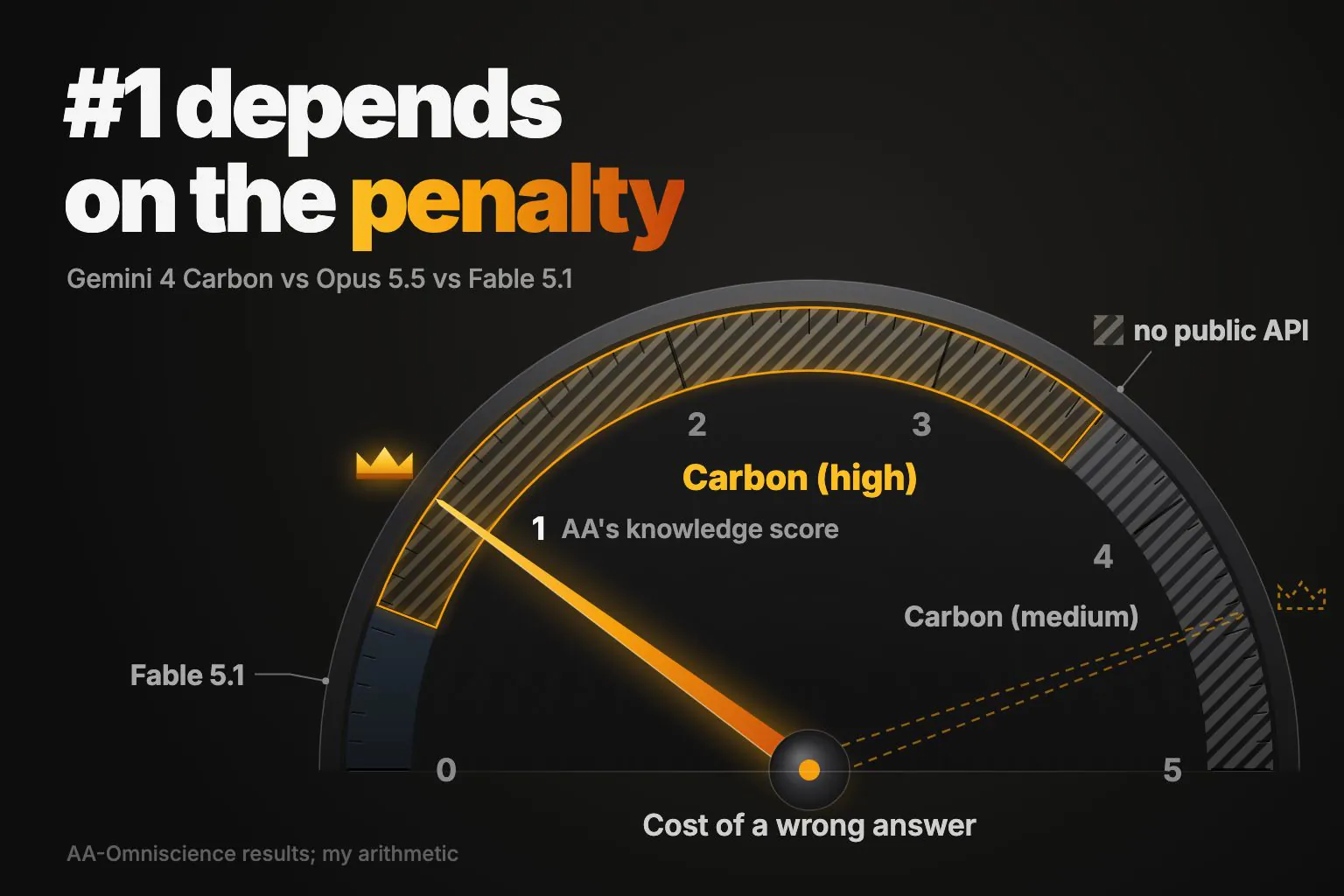
So which model wins depends on what a wrong answer costs you
AA scores the knowledge test itself as right minus wrong, so one mistake cancels one right answer. Change that cost and the crown moves, sometimes to Anthropic's pricier Fable 5.1.
Your number is cleanup time divided by lookup time. When a model says "I don't know", you look the fact up yourself. A right answer saves you that lookup, and a wrong one leaves you the lookup plus the cleanup.
A date in a draft might take five minutes to look up and a minute to fix, so 0.2. A figure in a client email takes five minutes to check and an hour to correct, so 12.
Once a mistake costs about four right answers, Opus 5.5 scores below a model that answers nothing at all. For a dosage or a filed citation, check every answer, whichever model you use.
What I'd call today
You can't call Carbon yet, so for facts I'd use Opus 5.5 at max effort if a wrong answer costs about one right one or less. Above that, I'd use Gemini 4 Argon, the Gemini 4 model you can call. I'd skip Fable: about 3 more right per 100 costs two and a half times the price.
What I still don't know is when Carbon ships. The day it gets a public API, I'd read that dial again.
More from the Blog
NVIDIA MotionBricks: The 15,000 fps Isn't the News
MotionBricks' 15,000 fps is mostly a counting choice. I ran it on a laptop. The news is fast, smooth and accurate at once, enough to replace game transitions.
ChatGPT Images 2.6 GIFs Act Like Sprite Sheets: They Keep the Look, Lose Count
ChatGPT Images 2.6 GIFs behave like one sprite sheet cut into frames, so they keep the look and lose count. In 18 juggler runs, none kept three balls.