Higgsfield vs ComfyUI: A Fight Over a Name, While Most Rebuilt Apps Are One Prompt
Higgsfield's letter to ComfyUI goes after a name, not the apps. In one open rebuild, 72 of 120 apps are one prompt, and a swap costs $2.21 or 32 minutes.
On October 28, Higgsfield's lawyer sent ComfyUI a cease-and-desist. Higgsfield sells AI video apps to nearly a million subscribers, and ComfyUI, the open-source tool for wiring AI models into workflows, was running "Open Source Higgsfield", a $25,000 contest to rebuild those apps in the open. Comfy posted the letter with a warning: "They want the Open Source Higgsfield challenge taken down within 48 hours."
I read all three pages, and they ask for less: drop the name, pull a promo video with Higgsfield's CEO under that headline, keep your documents. The letter takes no issue with "inviting developers to build their own tools". I think Higgsfield is right about the name, and that's the smaller story. The bigger one is that most of the best-documented rebuild's menu is one sentence of prompt.
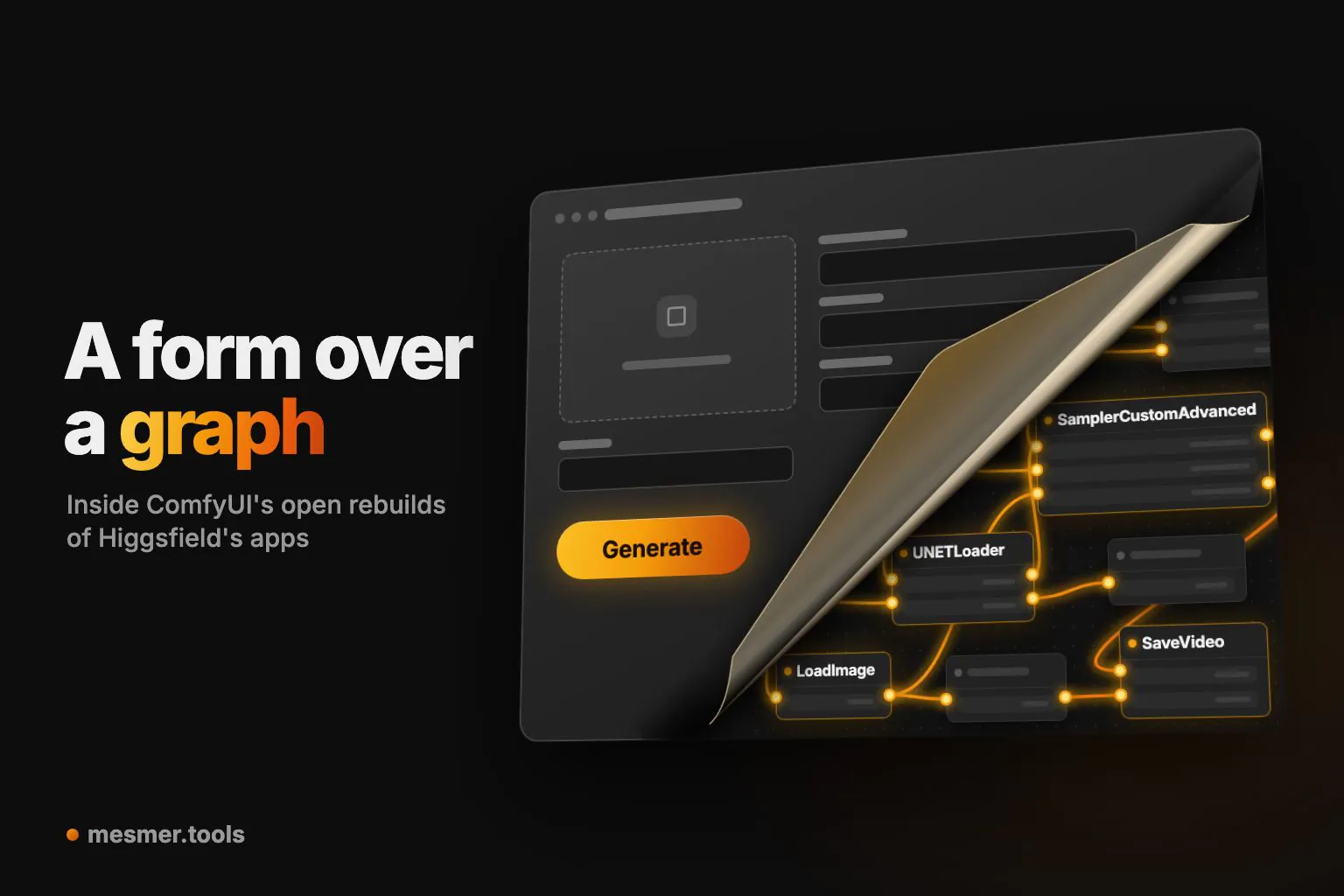
Higgsfield is right about the name
The obvious defence is that you can use a rival's name to refer to the rival. The letter goes straight at it: "It uses the HIGGSFIELD Mark as the title of its own competition." I think that holds, because Higgsfield already runs a product called Open Higgsfield, its API console.
So I opened a clone to see what an app is
The letter leaves the apps alone and Higgsfield doesn't say what's under them, so I went through the clone that documents itself best. Freefield, a contest entry, keeps each app in one folder: a ComfyUI workflow plus a file mapping form fields to nodes. This is its character swap, Recast.
But Recast has a workflow of its own, and most of the menu doesn't. Packshot, Victory Card and Bullet Time look like three products, and they're rows in one Python table. 72 of the 120 apps work that way: a fixed prompt over a pipeline another app already runs.
I can't prove Higgsfield's menu is built the same way, but if a good prompt over a rentable model is a product, anyone can ship it: Openjutsu, the most-starred contest entry, is a swap app built during the contest, mostly with Claude. So my guess is that Higgsfield's protection sits in closed models like Seedance and Veo, which nobody can self-host, and in being where its subscribers already pay.
So Higgsfield vs ComfyUI comes down to dollars or minutes
Price a swap both ways. At 480p, 15 seconds costs $2.21 on Higgsfield's swap app. Openjutsu on an RTX 4060 Ti 16 GB takes up to about 32 minutes and 3 cents of power, by my scaling of its published time. Nobody keeps the first try with AI video, as the Seedance film budget shows, so this runs five tries.
When every attempt costs money, you stop at good enough. When it costs time, you queue ten overnight and keep the best.
The card is the catch. A 4060 Ti 16 GB runs about $843 in the US as of November 2026, which takes about 77 finished clips to pay back. If you don't own one, I'd rent first, and if you make a few clips a month or want Seedance or Veo, I'd keep paying.
If you own the card and mostly make swaps and effects, I'd set up ComfyUI and start with Openjutsu. It lists 12 custom node packs, so setup is real work.
What I still don't know is whether the output holds up. I haven't compared a rebuild against the original, and I found no test that has.
More from the Blog
NVIDIA MotionBricks: The 15,000 fps Isn't the News
MotionBricks' 15,000 fps is mostly a counting choice. I ran it on a laptop. The news is fast, smooth and accurate at once, enough to replace game transitions.
ChatGPT Images 2.6 GIFs Act Like Sprite Sheets: They Keep the Look, Lose Count
ChatGPT Images 2.6 GIFs behave like one sprite sheet cut into frames, so they keep the look and lose count. In 18 juggler runs, none kept three balls.