Kimi K3 on 8GB of RAM Is Real, and a Long Reply Takes a Day
Kimi K3 really runs under an 8 GB cap, but every token reads 135 GB, so a long reply takes most of a day. Why that happens, and what I'd do instead.
In November a Reddit post promised you could run Moonshot's 2.78-trillion-parameter Kimi K3 "With Just 8GB of RAM". The engine behind it, kimi-k3-in-c, is 176 KB of C, and its README lists 26.5 seconds per token on "an ordinary laptop". So I read the run behind that row.
It's real, and the output matches a big-memory run byte for byte. But the small print says that row ran on a 124-core server. It had 720 GB of RAM, fenced down to 8 GB in software. Every token still reads 135 GB, so a long reply takes most of a day, and for most prompts I'd use an API.
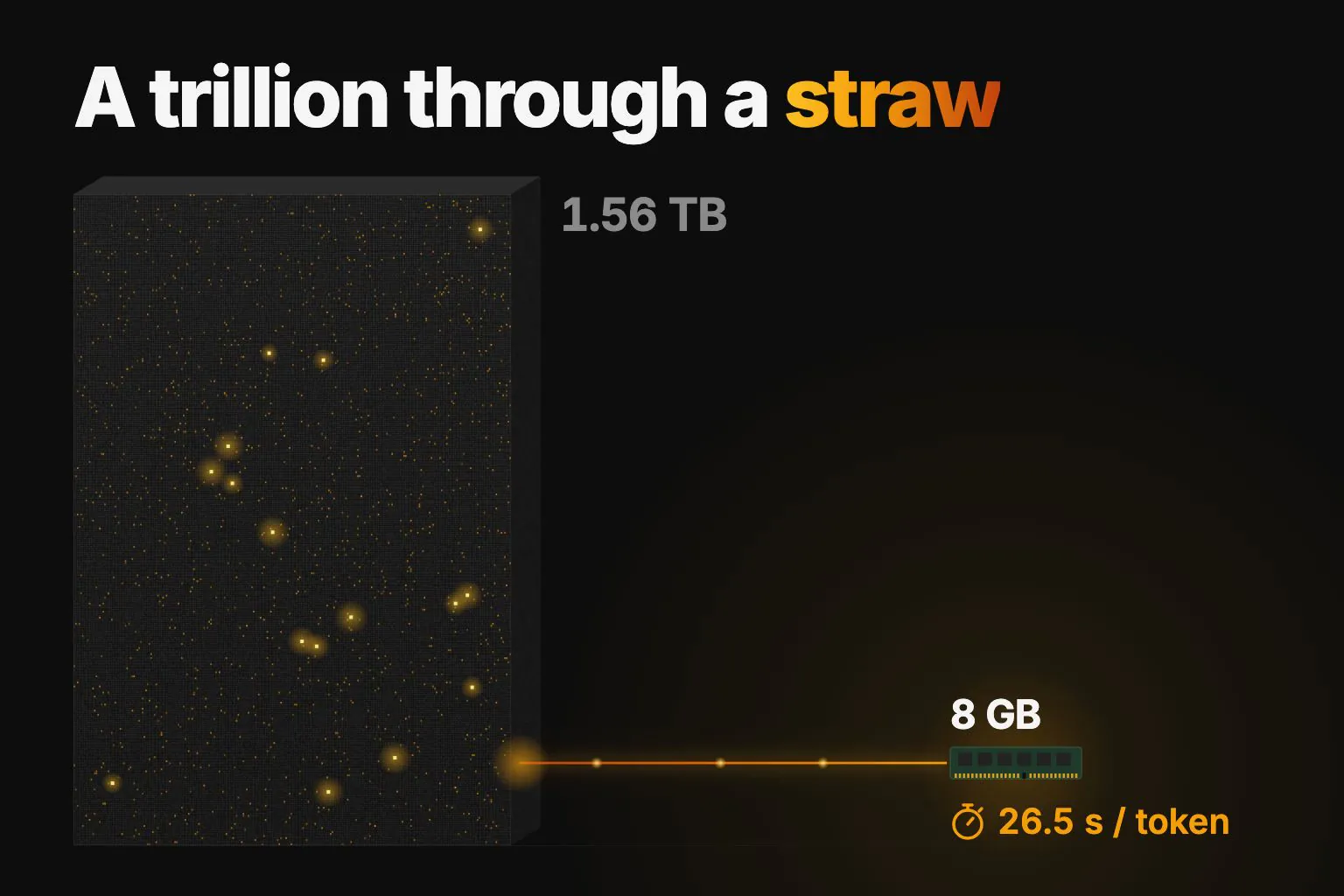
How a 2.78-trillion-parameter model fits in 8 GB
Kimi K3 is a mixture of experts. Picture a tall library where every question needs only 16 of the 896 books on each floor. Those books are the experts, 93% of the checkpoint, and they can stay on the SSD.
But every floor also has a reference desk you consult on every question, and those desks together are the trunk. Watch the two counters, not the lit cells.
So this engine's speed is your SSD divided by 135 GB
Seconds per token is one division: the gigabytes still on the disk for each token, over how fast the disk reads. I ran that on the 8 GB row and got 28.6 seconds, against 26.5 measured. So at this memory those 124 cores mostly wait for the drive.
Take a 3,000-token reply, thinking included, as my example. At the cap it reads 404 TB and takes about 22 hours. Here's that day.
But 64 GB of RAM barely helps
Eight times the memory only takes 26.5 seconds down to 19.8. That much holds about 40% of the trunk, and the pipe in this clip never gets faster.
Fit the whole trunk, about 130 GB free, and you get 5.6 seconds, the lowest published clock with byte-exact output. That reply still takes nearly five hours.
So I'd pay three cents instead
For most prompts I'd call the API. K3.1 Pro, Moonshot's newer model, costs about $10 per million output tokens as of November 2026, so that reply's output costs three cents.
If prompts can't leave the machine, I wouldn't use this engine for the work. If you do run it, buy the drive before the memory. One engine that stores the weights at lower precision fits the trunk in RAM and gets about 2 seconds a token on a new 64 GB MacBook Pro, at the cost of exact output.
What I still don't know is how this engine behaves on a real laptop. An M1 MacBook Pro has reproduced the output, but I can't find a timed run.
More from the Blog
NVIDIA MotionBricks: The 15,000 fps Isn't the News
MotionBricks' 15,000 fps is mostly a counting choice. I ran it on a laptop. The news is fast, smooth and accurate at once, enough to replace game transitions.
ChatGPT Images 2.6 GIFs Act Like Sprite Sheets: They Keep the Look, Lose Count
ChatGPT Images 2.6 GIFs behave like one sprite sheet cut into frames, so they keep the look and lose count. In 18 juggler runs, none kept three balls.