Why DeepSeek V4.1 Flash Is So Cheap, and Why the Price Can Last
DeepSeek V4.1 Flash is cheap because an agent's re-reads come off nearly free disk. A modeled week costs 72 cents against $44 on Opus, and the price can last.
In the docs for its open-source serving software, DeepSeek wrote down what its GPUs bring in:
A single cluster currently serves 155 trillion tokens per day, with overall revenue of US$38 per GPU-hour (at the off-peak price).
People ran that through a calculator and called it the zero-profit price of a million tokens. I cared because DeepSeek's models went from 27% of the tokens on OpenRouter, an API marketplace for models, the day V4.1 Flash shipped to 55% on November 4, and the doc explains why. V4.1 Flash is cheap because a coding agent mostly re-reads its own conversation, and DeepSeek answers a re-read from disk. That disk is a rounding error next to the $38, so I think the price can last.
And that 55% is the small number.
A re-read is a disk read
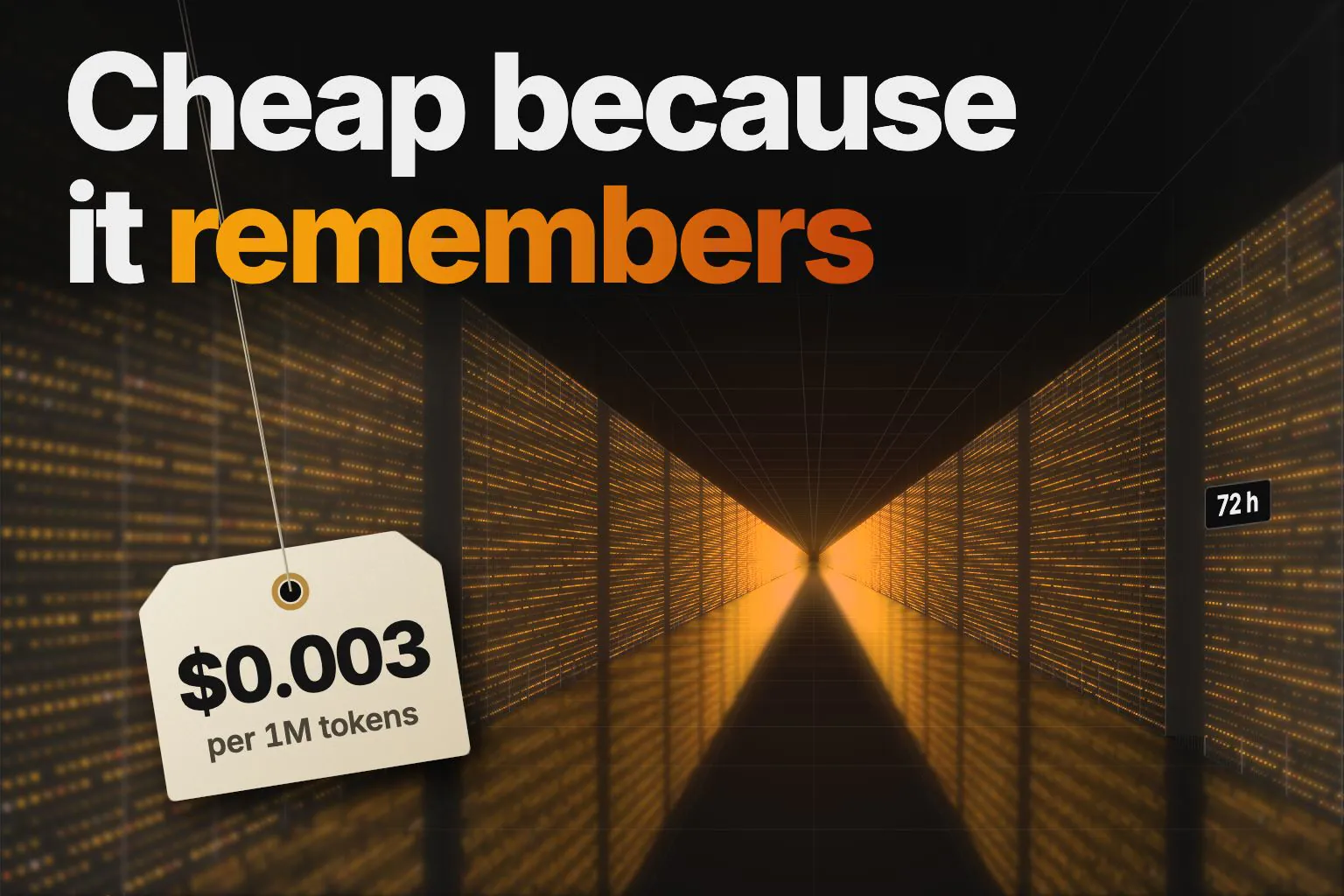
An agent resends its whole conversation on every step, so I'd bet most of those tokens are re-reads. On a cache hit, DeepSeek loads the saved keys and values (the KV cache) from disk and computes only what's new. Off-peak, that hit costs $0.003 per million tokens. Here's one request sent twice.
But those files have to live somewhere. By my math a 150,000-token conversation takes about 130 MB, and DeepSeek keeps it for at least 72 hours. At retail drive prices, holding it that long costs about what one re-read bills, and an agent re-reads hundreds of times.
The disk is the smallest line in DeepSeek's margin
Back to that $38, which is revenue. DeepSeek doesn't say what a GPU-hour costs it, so rent has to stand in, about $8 for an Nvidia B200, and the disk adds about 50 cents. Try your own GPU price.
What a GPU-hour costs DeepSeek
Drag to set the GPU cost. Revenue is fixed at $38 per GPU-hour.
Cached input
$0.0007
break-even, vs $0.0030 list
Fresh input
$0.034
break-even, vs $0.150 list
Output
$0.134
break-even, vs $0.600 list
Even at the $14 a big cloud charges, more than half is left before training and staff, so the price has room.
A week of agent work on V4.1 Flash: 72 cents against $44
I modeled what that price buys: a developer's week on one 150,000-token session over 600 steps. At list prices that's 72 cents on DeepSeek off-peak and $44 on Claude Opus 5.5.
Bill every step as a miss and DeepSeek costs $14, so cheap fresh tokens get you to a third of Opus and the cache does the rest. Look at what each morning does to Claude.
Real runs narrow the gap: in my Claude Code alternatives tests, V4.1 Flash cost about a twelfth of what Claude Sonnet 5.5 did, where my week says a thirtieth.
Where I'd send my own code
But DeepSeek's API runs from China, so some code shouldn't go there. Plenty of hosts match its price list, but none I found promises its memory, and I haven't measured any of them. I priced a short memory at DeepSeek's own rates.
With my own money, personal and open-source work goes to DeepSeek off-peak. Anything I wouldn't send to China goes to a Western host that routes my session back to the same server, since that's where its cache lives.
What I still don't know is how long those Western caches really last. DeepSeek has published its blueprint and the disk is cheap, so any host with enough traffic could copy it. Whichever does is the one I'd use.
More from the Blog
NVIDIA MotionBricks: The 15,000 fps Isn't the News
MotionBricks' 15,000 fps is mostly a counting choice. I ran it on a laptop. The news is fast, smooth and accurate at once, enough to replace game transitions.
ChatGPT Images 2.6 GIFs Act Like Sprite Sheets: They Keep the Look, Lose Count
ChatGPT Images 2.6 GIFs behave like one sprite sheet cut into frames, so they keep the look and lose count. In 18 juggler runs, none kept three balls.